





Best 1000W Car Inverters 2026: Top Models Compared
- How to choose the right 1000W inverter for your vehicle
- Understand the : what users really want
- Key specs to prioritize for a 1000W car inverter
- Top 1000W car inverter types compared (2026)
- Category overview: pure sine vs modified sine vs inverter/charger
- When to pick each type
- Comparative specs: what a real 1000W inverter looks like
- Interpreting surge and continuous ratings
- Certifications and quality indicators
- Installation, safety and performance: practical advice
- Battery and cable considerations
- Thermal management and mounting
- EMI, noise and grounding
- Top use-case scenarios and real-world advice
- Powering a CPAP on overnight drives
- Running power tools and microwaves
- Remote work and mobile offices
- Why manufacturer quality matters — Guangzhou Congsin’s strengths
- Final recommendations and buying checklist
- Quick buying checklist
- Where to get reliable specs
- FAQ
- Q1: Can a 1000W car inverter run a microwave?
- Q2: Is a pure sine wave inverter necessary for laptops and chargers?
- Q3: How long will a 12V car battery run a 1000W inverter?
- Q4: What safety protections should an inverter have?
- Q5: Can I run power tools from a 1000W inverter?
- Q6: How do I choose cables and fuses?
- Contact and next steps
I’ve spent decades designing, testing and advising on DC→AC power conversion systems for vehicles, RVs and portable power applications. In this guide I break down what matters when you’re shopping for a car inverter 1000 watt class in 2026: real-world performance, waveform type, installation and safety, efficiency and losses, and which features deliver the best value for common use cases. I’ll compare the primary 1000W inverter categories, give a practical spec table for quick selection, and explain why manufacturer quality and certifications (ISO9001, CE, FCC, etc.) matter for reliable performance in the field.
How to choose the right 1000W inverter for your vehicle
Understand the : what users really want
When people search for “car inverter 1000 watt” they usually want a device that (1) powers common AC appliances from a 12V/24V vehicle battery, (2) fits installation space and cable limitations, and (3) runs reliably without draining the vehicle battery or causing interference. Practical questions include: can it run a microwave, a laptop, a CPAP machine, or power tools? Will it start inductive loads? How efficient and quiet is it? My approach is to translate those intent items into measurable selection criteria: continuous vs peak wattage, waveform output, surge capacity, idle draw, cooling, safety protections and certifications.
Key specs to prioritize for a 1000W car inverter
Focus on:
- Continuous power rating (1000W) and surge rating (often 1500–2000W) — surge matters for motor-driven loads.
- Output waveform: pure sine wave vs modified sine wave — affects compatibility and EMI.
- Efficiency at typical load (look for 85–95% at 50–75% load for good designs).
- No-load/idle power draw — lower is better for long idle periods.
- Protections: undervoltage, overvoltage, overtemperature, short-circuit, reverse polarity.
- Certifications and quality system (ISO9001, CE/EMC, FCC, RoHS, ETL/E-MARK for automotive use).
For technical context on inverter fundamentals, see the inverter overview on Wikipedia: https://en.wikipedia.org/wiki/Inverter.
Top 1000W car inverter types compared (2026)
Category overview: pure sine vs modified sine vs inverter/charger
In 2026, buyers still choose among three practical categories for vehicle use:
- Pure sine wave 1000W inverters — best compatibility with electronics, quieter and more efficient for sensitive loads.
- Modified sine wave 1000W inverters — lower cost, OK for resistive loads but can cause noise/inefficiency and may damage some devices.
- 1000W inverter/charger or hybrid units — include charging or power-management features; useful in RVs and vehicles with integrated battery systems.
For a technical explanation of waveform differences and why sine purity matters, review the sine wave resource: https://en.wikipedia.org/wiki/Sine_wave.
When to pick each type
If you frequently run laptops, medical devices, sensitive power supplies, modern TVs or audio equipment, choose a pure sine wave 1000W inverter. For intermittent resistive loads (incandescent lamps, some heaters) with strict cost limits, a modified sine wave may suffice. If you need integrated battery charging and shore-power management for an RV or mobile office, consider inverter/charger hybrids even at the 1000W power tier.
Comparative specs: what a real 1000W inverter looks like
Below I present a concise comparison table of typical 1000W inverter specifications by category. These are representative ranges sourced from manufacturer datasheets and industry norms — use them to set expectations when comparing specific models.
| Category | Typical Continuous Output | Typical Surge Capacity | Efficiency (typical at 50% load) | Idle Draw | Best For |
|---|---|---|---|---|---|
| Pure Sine Wave 1000W | 1000 W | 1500–2000 W | 90–95% | 0.5–2 A | Laptops, CPAP, audio, sensitive electronics |
| Modified Sine Wave 1000W | 1000 W | 1200–1800 W | 80–90% | 1–3 A | Resistive loads, budget setups |
| 1000W Inverter/Charger (Hybrid) | 1000 W | 1500–2000 W | 88–94% | 0.8–2.5 A | RVs, integrated battery systems, mobile offices |
Sources for typical efficiency and surge norms include manufacturer datasheets and inverter primers such as the U.S. Department of Energy materials on inverter basics: https://www.energy.gov/eere/solar/articles/solar-inverter-basics.
Interpreting surge and continuous ratings
Many buyers misinterpret surge numbers. A 1000W inverter with a 2000W peak can start inductive motors (compressors, pumps) briefly, but continuous power must remain within 1000W. Always measure or estimate startup current for your loads and choose an inverter with adequate surge margin and current limits. I recommend a surge margin of 1.5–2× for motors, and dedicated fusing/cable sizing to handle peak currents.
Certifications and quality indicators
Certifications matter: CE/EMC/LVD for European markets, FCC for radiated emissions, RoHS for hazardous substances, ETL/UL for North American safety, and E-MARK for automotive homologation in some regions. Also verify the manufacturer has a documented quality system such as ISO9001 — ISO’s overview is here: https://www.iso.org/iso-9001-quality-management.. A quality management system reduces unit-to-unit variation and improves long-term reliability.
Installation, safety and performance: practical advice
Battery and cable considerations
For a 1000W inverter at 12V, continuous current draws ~83–90 A (1000W / 12V = 83A, accounting for 90–95% efficiency). That means cables and fuses must be sized to handle >100A peaks. Use short, heavy-gauge cables (e.g., 2–0 AWG or equivalent for many installations) and mount an appropriately rated fuse at the battery positive. Proper cable sizing is one of the most common causes of voltage drop and overheating in vehicle inverter installs.
Thermal management and mounting
Inverters need ventilation; install them where airflow is unobstructed and away from direct heat sources. Overtemperature shutdowns are common if you mount an inverter in a confined compartment without airflow. Look for units with thermal throttling and clear installation instructions.
EMI, noise and grounding
Inverters can introduce electromagnetic interference. Proper grounding, using shielded AC cables for audio/video and avoiding running signal cables parallel to high-current DC runs helps. If you are powering sensitive radio equipment or audio systems, a high-quality pure sine inverter with proper filtering reduces hum and interference.
Top use-case scenarios and real-world advice
Powering a CPAP on overnight drives
Medical devices like CPAP machines often require pure sine power to run reliably and quietly. Check manufacturer specs for both continuous power and surge; many CPAP units have moderate startup draws. For overnight use I always recommend a low idling-draw inverter and a separate deep-cycle AGM or lithium auxiliary battery to avoid depleting the vehicle starter battery.
Running power tools and microwaves
Tools and microwave ovens have high startup demands. A 1000W continuous inverter can run some small microwaves or drills, but you must account for starting currents. If you expect heavy transient loads consistently, consider a 1500–3000W inverter or parallel battery/inverter systems to protect unit lifespan.
Remote work and mobile offices
For laptops, monitors and small printers, a 1000W pure sine inverter covers most needs. Pay attention to idle draw if you leave the inverter on while devices sleep. If you commute long distances and need always-on power, optimize for high efficiency at low loads and choose an inverter with good ECO or standby modes.
Why manufacturer quality matters — Guangzhou Congsin’s strengths
Supplier reliability affects product safety, warranty support, and long-term performance. Guangzhou Congsin Electronic Technology Co., Ltd., founded in early 1998, is a professional power inverter manufacturer with over 27 years of focused experience. We design, R&D and manufacture a wide range of power solutions—with a core emphasis on DC→AC power inverters, portable power stations, and solar charge controllers. Our catalog includes 100+ models tailored for vehicles, solar systems, RVs and trucks, off-grid homes, outdoor offices, patrol and field construction work.
We operate fully automated production lines, advanced instrumentation and multifunctional testing equipment to ensure product reliability, efficiency and intelligent functionality. Environmental and safety compliance are built in: our quality system is ISO9001 certified and many products hold international approvals such as CE, EMC, LVD, ETL, FCC, RoHS and E-MARK. Several independently developed patents further demonstrate our commitment to innovation.
Congsin’s products serve global markets across Europe, the Americas, the Middle East, Africa and Southeast Asia; many models are supplied to domestic and international OEM channels. Our support includes OEM/ODM, private labeling, distribution and bespoke customization to meet partner specifications. Our mission is to deliver reliable, efficient and affordable energy solutions that enable energy independence.
Key competitive differentiators I’ve verified in Congsin’s approach include:
- Long track record (est. 1998) with vertically integrated manufacturing and automated production lines, reducing variation and improving consistency across 1000W inverter models.
- Comprehensive certification coverage (ISO9001, CE, ETL/FCC where applicable), which speeds regulatory acceptance in export markets and signals robust design controls.
- Extensive product range (including modified sine wave inverter, pure sine wave inverter, portable power stations, and solar charge controller solutions), enabling system-level compatibility for vehicle and off-grid installations.
If you are sourcing at scale, Congsin’s OEM/ODM service and ability to produce E-MARK and other automotive-appropriate approvals can reduce time-to-market for vehicle-integrated inverter solutions.
Final recommendations and buying checklist
Quick buying checklist
- Choose pure sine 1000W if you run sensitive electronics or medical devices.
- Check surge rating vs expected startup current and size cables/fuses accordingly.
- Confirm certifications (CE, FCC, ETL, RoHS, E-MARK) and ISO9001 manufacturer practices.
- Verify idle power draw and inverter efficiency at your expected load profile.
- Plan mounting and cooling to avoid thermal derating.
Where to get reliable specs
Always download the technical datasheet from the manufacturer’s website and verify: continuous/peak power, waveform, efficiency curves, idle consumption and protection setpoints. For industry context on certifications and product marking, consult the EU CE-marking guidance: https://ec.europa.eu/growth/single-market/ce-marking_en.
FAQ
Q1: Can a 1000W car inverter run a microwave?
Possibly, but many microwaves require higher surge currents or continuous power beyond 1000W. Check the microwave’s wattage and starting demand. Small 600–800W microwaves can often run, but expect the inverter to operate near capacity; a larger inverter is recommended for frequent use.
Q2: Is a pure sine wave inverter necessary for laptops and chargers?
Most modern laptop chargers work on modified sine wave, but pure sine avoids potential issues like overheating, buzzing, or reduced charger lifespan. I recommend pure sine for frequent, long-term use to protect sensitive electronics.
Q3: How long will a 12V car battery run a 1000W inverter?
Run time depends on battery capacity (Ah), inverter efficiency and depth-of-discharge. Example: a 100Ah 12V battery holds ~1200 Wh usable at full charge; at 1000W inverter draw and 90% efficiency you’d get roughly 1–1.2 hours. For reliable operation, use deep-cycle batteries or lithium systems sized for your desired runtime.
Q4: What safety protections should an inverter have?
Essential protections include undervoltage/overvoltage shutdown, overtemperature shutdown, short-circuit protection and reverse polarity protection. Automotive-rated E-MARK or similar certification also ensures design considerations for vehicle environments.
Q5: Can I run power tools from a 1000W inverter?
Light-duty tools (drills, small grinders) sometimes work if surge ratings cover startup current. Heavy tools and sustained loads are better served by larger inverters. Be cautious about continuous load percentages and motor starting currents.
Q6: How do I choose cables and fuses?
Size cables to handle continuous current plus a safety margin — for 1000W at 12V expect ~85–100A continuous, so choose heavy-gauge (e.g., 2–0 AWG or equivalent depending on length) and install an appropriate fuse at the battery positive near the battery. Consult the inverter manual for exact wire gauge recommendations.
Contact and next steps
If you want product recommendations tailored to a specific vehicle, load list, or installation environment, I can evaluate your use case and suggest models (pure sine, modified or hybrid) and a wiring/fuse plan. For commercial sourcing, Guangzhou Congsin offers a broad 1000W-class lineup, OEM/ODM services and international certifications that simplify integration and market entry. Contact Congsin or view their product range to request datasheets, certificates and customization options.
For more on inverter basics and standards, see the inverter article on Wikipedia: https://en.wikipedia.org/wiki/Inverter, and ISO information here: https://www.iso.org/iso-9001-quality-management.. For guidance on CE marking and market compliance, see: https://ec.europa.eu/growth/single-market/ce-marking_en.
Ready to discuss your exact requirements? Contact our team to request product datasheets, certifications, OEM/ODM options and pricing — we’ll help you choose the best 1000W car inverter solution for your needs.
Comparing Modified vs Pure Sine Wave Car Inverters
How to Choose Right Wattage Car Power Inverter
Top Features to Look for in a UPS Power Inverter
Load Compatibility and Efficiency with Modified Sine Wave Inverters
Modified Sine Wave Inverters
How to connect the battery with the battery clip?
Connect the positive and negative poles of the battery clip to the positive and negative poles of the battery respectively, and ensure a firm connection.
Does it only support DC12V input voltage?
The regular model has DC12V input, and other input voltages such as DC24V can be customized. Please consult customer service for details.
Does it have protection features?
Yes, it includes overload, overheat, and short-circuit protection.
How many devices can it power at the same time?
Dual universal sockets + two USB ports can power multiple devices (such as two home appliances + two mobile phones) at the same time, as long as the total power does not exceed 600W.
Distributor
Do I need to carry inventory?
We offer flexible inventory options based on your market needs, and we can assist with supply chain management.
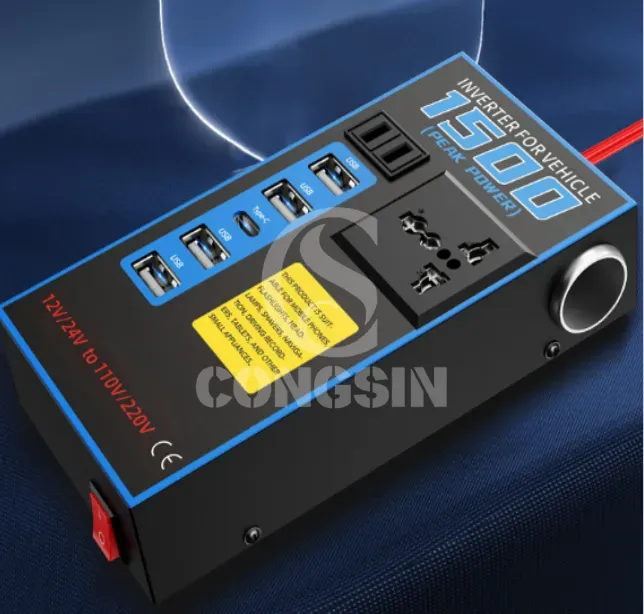
Congsin 1500W Inverter for Vehicle DC 12V/24V to AC 110V/220V with Universal socket Modified Sine Wave
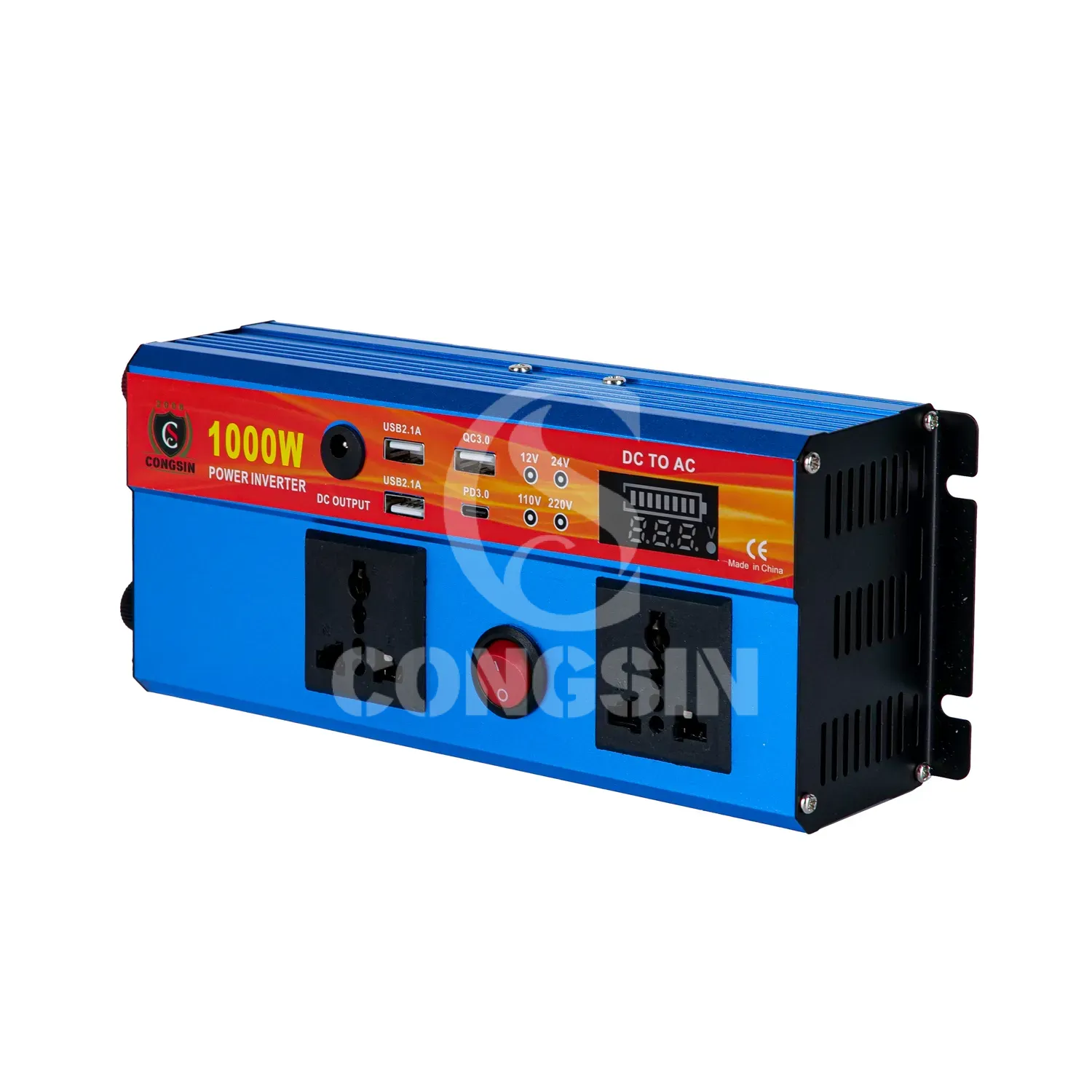
Congsin 1000W modified sine wave inverter with LED display and Type C port car RV power inverter
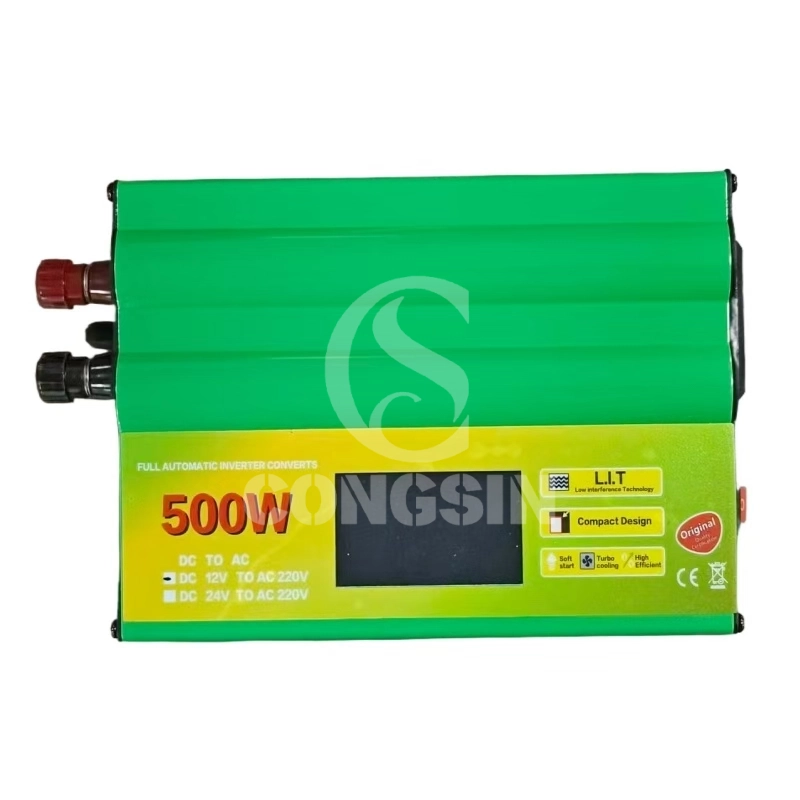
Congsin Modified Sine Wave Inverter 500W 1000W 1500W 12V LED Display Portable for RV Car Solar
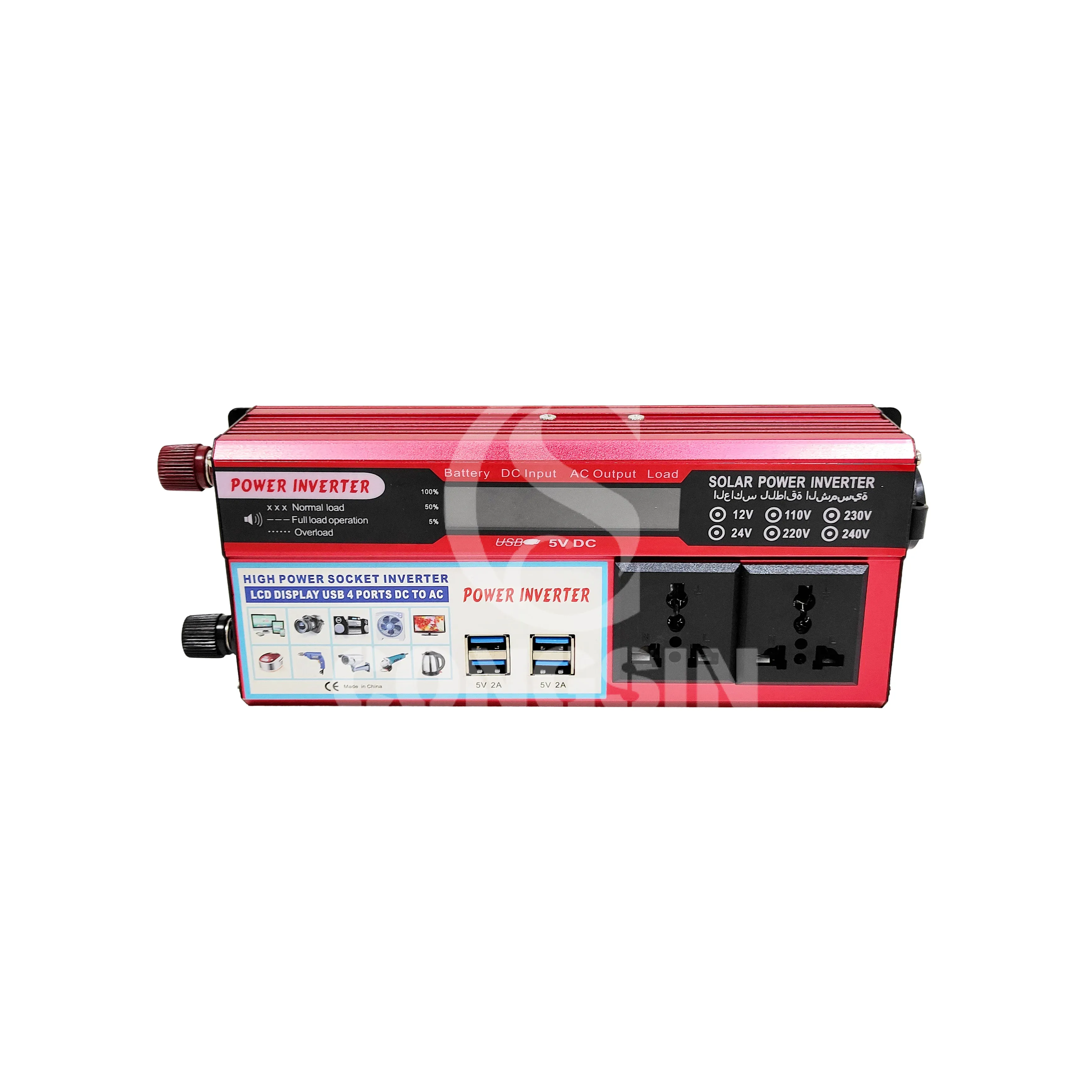
Congsin 1500W modified sine wave inverter with LCD display and USB ports for RV car boat home use

CONGSIN is a trusted OEM factory for power inverters, solar charge controllers, and DC converters. Reliable solutions for global B2B buyers.
 High Quality
 7/24 Service
 Guaranteed Warranty
© 2025 Congsin. All Rights Reserved.